
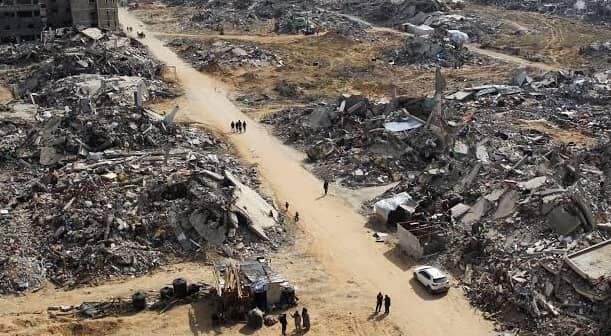
Palestine Media Agency – Pmedia – A joint report by Oxfam and the Conflict and Environment Observatory has warned that more than 99% of the Gaza Strip's area faces significant environmental pollution risks caused by the ongoing Israeli military aggression.
The report, titled "Environmental War Crimes," highlighted that extensive bombings, fires, and destruction of critical infrastructure have led to widespread contamination of air, soil, and water throughout the besieged territory. Spatial analysis based on satellite imagery revealed that approximately 78% of Gaza’s land has been directly and materially affected.
The most affected and polluted areas include Gaza City, Khan Younis, Rafah, Jabaliya, and regions along Salah al-Din Road, where heavy metals, explosive remnants, asbestos from destroyed buildings, dioxins, and hazardous biological pollutants have been detected.
The report warned that dust generated by demolished buildings and waste burning releases fine particles causing chronic respiratory diseases, particularly among children and pregnant women in northern Gaza and Jabaliya. Contaminated clay soils in Beit Hanoun, Wadi Gaza, and northeast Khan Younis pose threats to agricultural crops.
Oxfam's Executive Director Amitabh Behar stated that Palestinians are directly exposed to these toxic substances through polluted air, unsafe food, and water, emphasizing that environmental and health consequences will persist for decades without urgent international cleanup plans.
The report also spotlighted the catastrophic collapse of water and sewage systems, with only 19% of wastewater pumps partially operational. Destruction of networks results in approximately 40,000 cubic meters of untreated sewage flowing daily into the Mediterranean Sea and large amounts seeping into groundwater via absorption pits. Recent lab tests detected fecal coliform bacteria in 19% of tested groundwater wells, a sharp rise from 2% pre-aggression, severely threatening remaining drinking water sources.
United Nations-affiliated sources estimate that Israeli military operations generated over 61 million tons of debris containing chemicals and unexploded ordnance, impeding safe access to large land areas and obstructing recovery efforts.
Water and sanitation specialist Lama Abd al-Samad from Oxfam warned that reconstruction efforts without comprehensive environmental field assessments carry severe risks. She pointed out the occupation’s continued refusal to permit entry of independent environmental experts and advanced inspection equipment to accurately assess the environmental disaster’s scope.
The report highlighted that ongoing airstrikes and shelling increase near-surface air pollutant concentrations, causing respiratory and skin diseases that burden medical teams, complicated by accumulated rubble and waste that occupation forces prevent removing.
It revealed that destruction of industrial facilities and workshops led to leakage of complex oils and chemicals into soil, contributing to cancer and congenital malformation risks, jeopardizing the future of Palestinian generations due to destructive occupation policies.
Analyses showed that agricultural lands, once Gaza’s food basket, suffered systematic leveling and phosphorus and incendiary bomb attacks, contaminating topsoil and aiming to render the strip uninhabitable even after cessation of direct hostilities.
International organizations called for global pressure on Israeli authorities to open crossings and deliver fuel urgently needed to operate water and sewage treatment stations. They also urged forming an international committee to assess environmental damages and start removing contaminated rubble following global health standards to avert an imminent epidemic.
The report concluded that the environmental destruction in Gaza constitutes deliberate ecological war crimes warranting international accountability. Restoring environmental balance requires billions of dollars and decades of continuous work, contingent on ending the aggression and lifting the comprehensive siege on the population.