
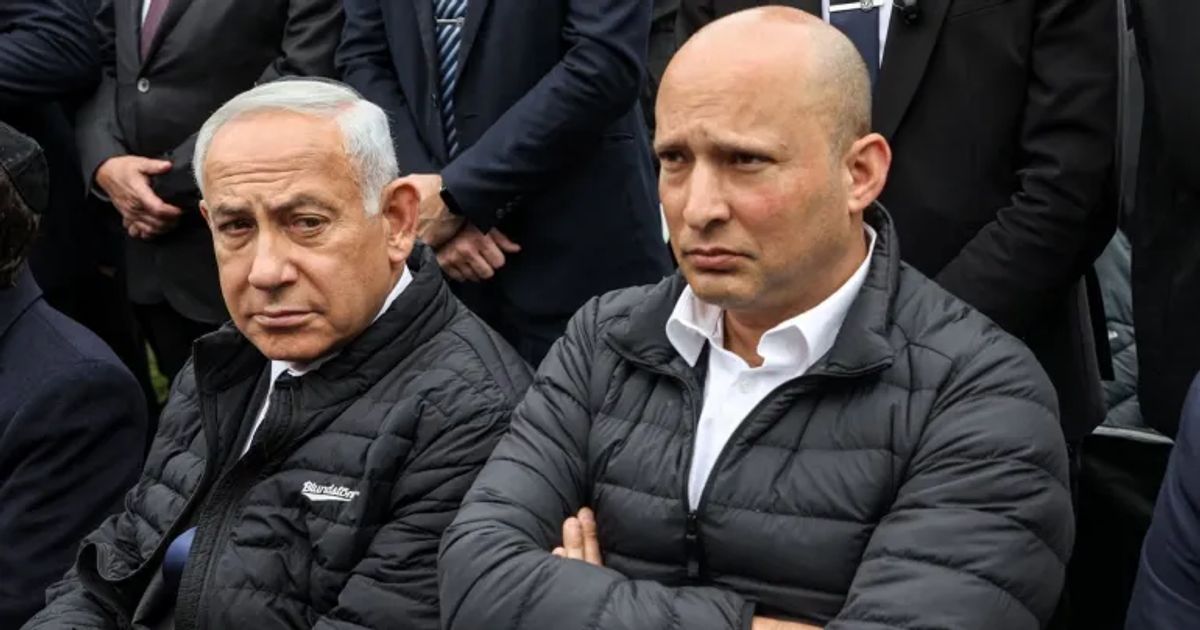
Palestine Media Agency – Pmedia – Political sources have revealed intensive secret communication channels between Naftali Bennett, leader of the "Yahad" party, and Benjamin Netanyahu, outgoing prime minister of the occupation government, conducted away from Bennett’s partners in Eizenkot’s alliance. These communications come despite previous understandings that any negotiations with the Likud party would be managed by a unified official team representing all opposition coalition members.
These side negotiations are reportedly serious, involving daily message exchanges, surpassing the official public pathway for forming a national unity government. They focus on critical issues like the identity of the next prime minister and the coalition’s ministerial composition—topics not deeply addressed in the formal sessions which mostly covered secondary matters.
Although Bennett outright denies parallel talks, leaked information confirmed a private meeting between Shalom Shlomo, Bennett's close associate, and Mikhail Rabello, Netanyahu’s representative, at a hotel in occupied Herzliya following an official negotiation session, supporting the existence of a back-channel aiming for bilateral agreements separate from other opposition parties.
These secret talks paved the way for a direct meeting between Netanyahu and Bennett at the Knesset last week, triggering sharp questions within Eizenkot’s camp about Bennett’s commitment to prior agreements, especially his adherence to Eizenkot leading the government first under a proposed rotation.
In parallel, sources indicate Netanyahu offered Bennett a deal guaranteeing seven seats on the Likud list in upcoming elections for representatives from his camp, in exchange for Bennett splitting from Eizenkot’s alliance and joining Netanyahu’s side. Bennett denied these reports, yet their circulation reflects the deep mistrust and mutual doubts within the opposition coalition.
Estimates within the "Yahad" party suggest Bennett’s maneuvering power has significantly declined after Avigdor Lieberman signed a coalition agreement with the "Yeshar" party. This development weakened Bennett’s negotiating position and reduced his ability to impose conditions or block a government including the ultra-Orthodox "Haredim" parties, which he had previously relied upon.
Observers note Bennett’s difficult position, as he has yet to sign a coalition agreement with Yeshar despite available opportunities, while other alliance partners proceed with their arrangements. This delay fuels speculation about a potential sudden political shift favoring a return to his old alliance with Netanyahu.
Bennett’s office described these reports as "baseless lies" and "recycled misinformation" aimed at sabotaging efforts to form what they called a strong Zionist government. The statement affirmed all Yahad’s communications are fully coordinated with Yeshar’s leadership, denying any parallel negotiation tracks with Likud outside the agreed framework.
Political circles in occupied Jerusalem are closely watching the approaching deadline for Eizenkot’s government formation mandate, monitoring moves by Yair Golan, leader of the "Democrats," who also has yet to sign a coalition agreement. The coming days are critical for the opposition coalition’s survival against Netanyahu’s allure.
These developments reflect fragmentation within the occupation’s political landscape, where narrow party interests intertwine with efforts to form a stable government. Netanyahu still holds strong cards to exploit divisions within his opposition, leveraging personal ambitions of leaders like Bennett.
Should Netanyahu succeed in attracting Bennett or parts of his party, it would signal a total collapse of Eizenkot’s political project and a radical reshuffling in the Knesset. However, sources indicate Bennett’s defection would likely involve only a few of his party members, limiting the impact on parliamentary balances.
The lingering question is the price Bennett might pay for returning under Netanyahu’s wing, given their long history of personal and political conflicts. Political circles view such a move as political suicide for Bennett before his voter base, which supported him on promises of change and ending Netanyahu’s era.
In conclusion, political forces in occupied Jerusalem await the outcomes of ongoing public and secret negotiations. The political scene remains open to all possibilities, including the prospect of new elections if all parties fail to reach a coalition majority.