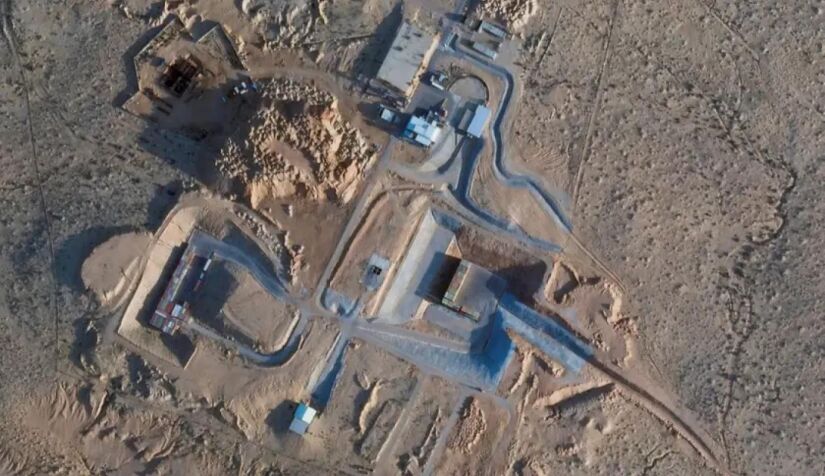
Palestine Media Agency – Pmedia – Recent reports by the Union of Concerned Scientists have identified a new circular building within the Dimona nuclear reactor site via satellite imagery, approximately matching the diameter of the existing reactor amid Israel's longstanding policy of nuclear ambiguity.
Updated estimates suggest the Israeli military possesses about 90 nuclear warheads, based on detailed calculations of plutonium stockpiles and delivery systems, supported by leaked documents and technical assessments of the occupied territories’ nuclear facilities.
The International Atomic Energy Agency has estimated the accumulated plutonium stockpile ranges between 800 and 1000 kilograms by early 2025, theoretically sufficient to produce up to 250 nuclear bombs, although Israel may retain a significant portion as strategic reserve rather than converting all into warheads.
The Israeli Air Force operates F-16 and F-15I fighter jets configured for nuclear missions with specialized crew training, and reports indicate that the advanced F-35I jets may have undergone secret upgrades enabling nuclear weapon carriage, though official confirmation is lacking.
Nuclear warheads are believed to be stored not at air bases but in highly secure underground facilities at undisclosed locations, with experts identifying Tel Nof and Tzirim bases as probable sites managed under stringent security.
The land-based arsenal includes Jericho missiles, with approximately 50 missiles housed at the Mech'a fields complex, where upgraded Jericho 3 missiles have a range up to 4000 kilometers, allowing strikes deep into Russia, Pakistan, and Iran.
High-resolution satellite images show fortified caves and bunkers serving as storage for mobile missile launchers, extensively renovated from 2014 to 2020 to accommodate up to 46 launch platforms.
At sea, Israel possesses six Dolphin-class submarines stationed in Haifa, equipped with unusual torpedo tubes believed capable of launching Popeye Turbo nuclear-capable cruise missiles, thus providing a sea-based second-strike capability.
Haifa naval base has undergone significant expansion to add covered docks intended to conceal submarine movements from surveillance and satellites, alongside contracts with Germany to acquire a new generation of submarines to replace older vessels, enhancing strategic naval capabilities for the coming decade.
Dimona reactor currently faces deterioration in its aluminum pressure vessel, a non-replaceable component signaling approach of the reactor’s operational end. Yet, Israel plans to continue operation until 2040 with extensive construction involving deep tunnel excavations and complex infrastructure near the reactor core.
These major construction activities—the largest in decades—might aim to extend the reactor’s life or build indigenous replacements amid restricted access to foreign reactor technology due to international legal barriers.
Israel’s non-membership in the Nuclear Non-Proliferation Treaty limits its access to official technical support for new reactor construction. The newly detected circular structures raise questions about future activities, whether for storage or other nuclear-technical purposes.
Political pressures have emerged unexpectedly within the U.S., with Congressional Democrats demanding an end to silence regarding Israel’s nuclear program and requesting detailed disclosures from the State Department, especially amid tight military cooperation and regional tensions.
Nevertheless, the U.S. administration maintains a policy of non-discussion on Israeli nuclear capabilities publicly, deferring inquiries to Israeli authorities and acknowledging that most countries are aware of the arsenal but that official recognition is avoided to preserve strategic balances.
من فلسطين إلى العالم
International Reports Reveal New Expansions at Dimona Reactor and Estimates of Israeli Nuclear Arsenal