
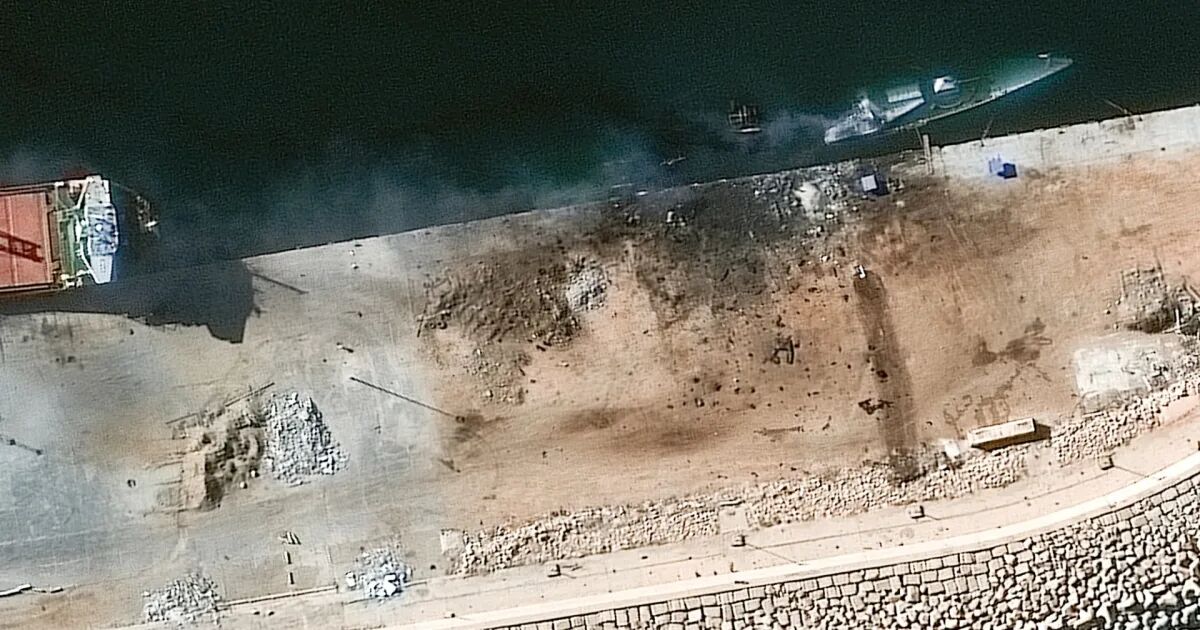
Palestine Media Agency – Pmedia – A Russian warship was targeted by maritime drones in the port of Benghazi, Libya, raising questions about the potential expansion of the Ukraine-Russia military conflict into the Mediterranean Sea.
Military experts view the attack as a strategic shift, reflecting Ukraine’s attempts to extend the conflict by targeting Moscow’s military and economic interests beyond its traditional Black Sea bases. According to Russian affairs researcher Mahmoud Al-Afandi, the responsibility for protecting Russian military vessels docked in Libyan ports primarily rests with Libyan authorities. He noted previous Russian warnings about suspicious activities and denied that the attack resulted from a Russian intelligence failure, describing it instead as direct Western escalation requiring advanced logistical and satellite support.
Meanwhile, Brigadier General Sayyed Ghanim emphasized that ship commanders retain responsibility for the protection of their vessels even while docked in foreign ports, maintaining high alert despite some systems being offline. He explained that the attack used seven fast maritime drones loaded with explosives, destroying a helicopter aboard the ship.
Mohamed Farajallah, Editor-in-Chief of Ukraine Arabic Agency, stated the operation aimed strategically to dry up funding sources for the Russian military. He noted the targeted ship was protecting Russia’s so-called “shadow fleet” involved in transporting oil and gold from Africa. Farajallah added that Ukraine’s military doctrine has evolved to pursue Russian presence globally, citing recent similar attacks on naval assets in the Kaliningrad region as evidence of an expanding maritime confrontation.
Officially, Libya’s Foreign Ministry in Tripoli condemned the military operation, rejecting the use of Libyan territory and territorial waters for settling international disputes, and warning against the conflict spilling over Libya’s internal affairs.
Observers suggest the incident may prompt Russia to enhance its Mediterranean defensive capabilities and reconsider port agreements amid unstable security conditions. The use of maritime drones presents a new regional security challenge, as these small, fast vessels are difficult to detect with traditional radar systems.
The attack highlights the complex security environment in Libya, where international conflicts impact national sovereignty and the protection of vital ports, raising questions about Russia’s likely response to this breach in a region critical to its interests. This development signals a potential escalation that may transcend the traditional geographical boundaries of the conflict centered in Eastern Europe.